Blog

How to Measure Training ROI: A Simple 4-Level Framework

SUMMARY
“They enjoyed the session” is not a business result. If training is an investment, prove it like one. This post walks you through 4 levels of measurement, from reaction to real results, plus a simple ROI formula and the one step most companies forget.

"Was the training worth it?"

Every CEO, finance director and HR head eventually asks this question. Too often, the only answer is a stack of feedback forms saying participants "enjoyed the session".

Enjoyment is nice, but it is not a business result. If training is an investment, it should be measured like one.

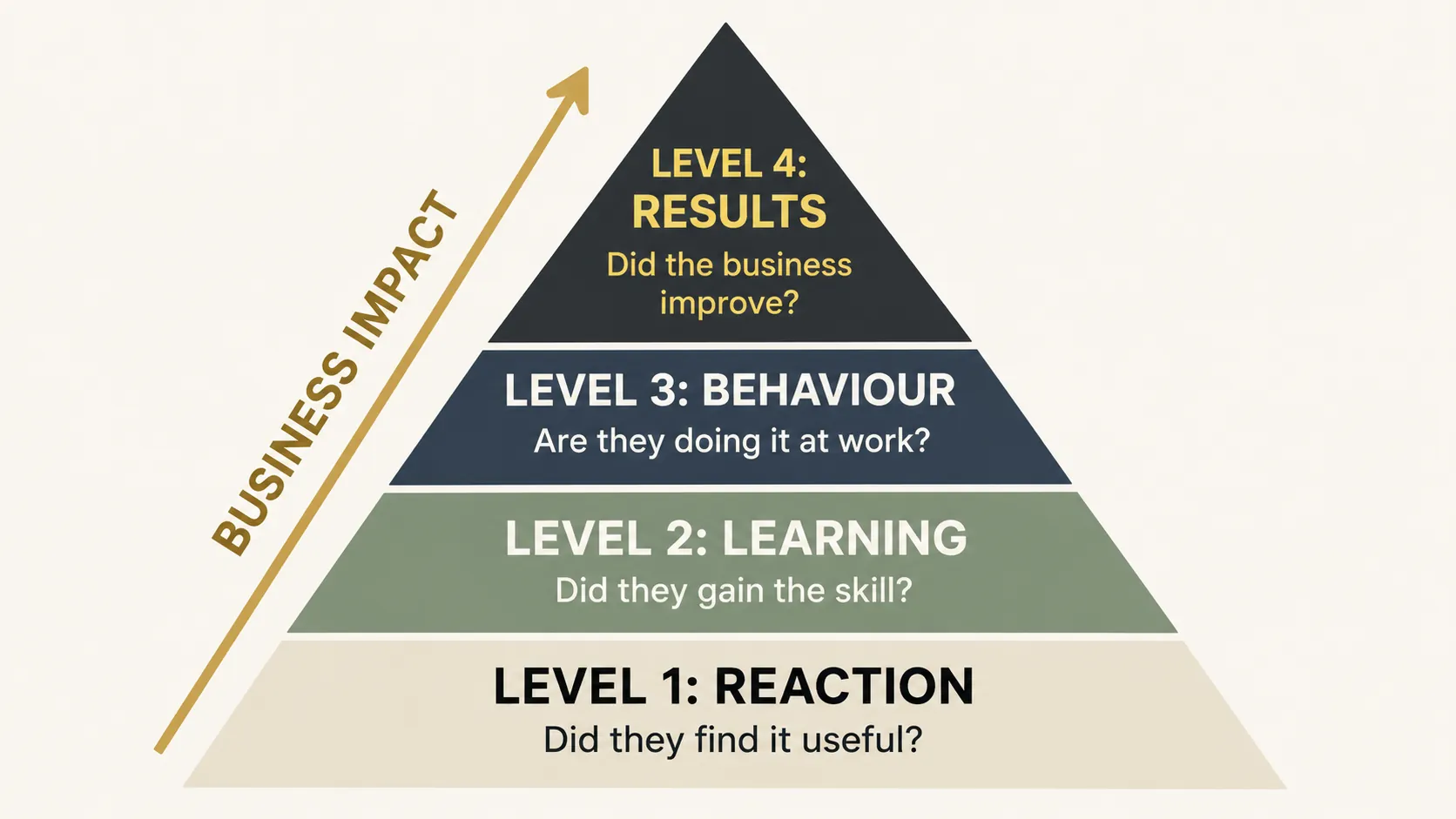
THE 4-LEVEL EVALUATION MODEL
The good news: you do not need complex systems. A simple four-level approach, based on the widely used Kirkpatrick model, can show what your training actually achieved.
LEVEL 01 · FOUNDATIONImmediate Post-Session

Level 1: Reaction — did they find it useful?

This is the feedback form at the end of the session. It is the easiest level to measure, and the least meaningful on its own.

Ask better questions. Instead of “Did you enjoy it?”, ask:
  • How relevant was this to your daily work?
  • What will you apply in the next two weeks?
LEVEL 02 · CAPABILITYDuring & End of Program

Level 2: Learning — did they gain the skill?

Check whether knowledge or skills actually improved.

How to measure: short quizzes before and after, role-play assessments or practical demonstrations during the program.
Example: Before a negotiation workshop, participants handle a mock objection poorly. After the program, they handle it with a clear, structured response.

LEVEL 03 · CRITICAL INFLECTION POINT30–60 Days Post-Training

Level 3: Behaviour — are they doing it at work?

This is where most training succeeds or fails. Knowing something is not the same as doing it.

How to measure:
Manager observations 30 and 60 days after the program
Simple behaviour checklists, such as “Holds weekly one-to-ones”
Peer or team feedback
Self-reported examples of applying the skill
LEVEL 04 · EXECUTIVE IMPACTBusiness Outcomes

Level 4: Results — did the business improve?

This is the level leaders care about most. Link the training to measurable outcomes.

Training typeResults you can track
Sales trainingConversion rate, average deal size, sales cycle length
Leadership trainingTeam turnover, engagement scores, internal promotions
Customer serviceComplaints, repeat customers, response time
Team alignmentProject delivery time, rework, cross-team issues
THE FINANCIAL FORMULA

Calculating a simple ROI

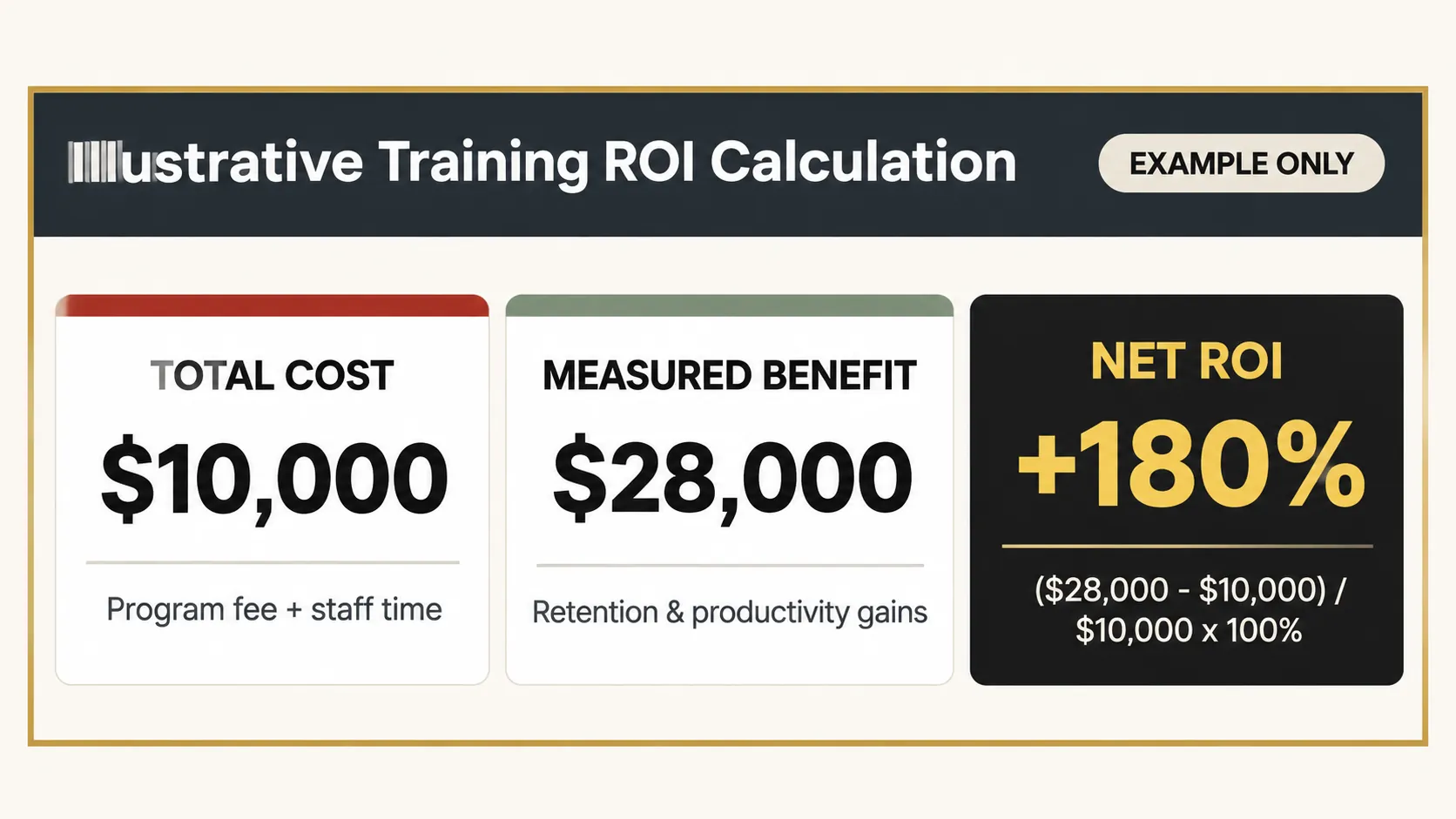
Once you have results, the basic ROI formula is:

ROI=Benefit − CostCost× 100%
COST
Includes the program fee and participants' time.
BENEFIT
The measurable gain, such as extra revenue or the saved cost of replacing staff who would otherwise have left.
Attribution note: Be honest about other factors. If sales rose because of a new product as well as training, acknowledge both.
THE ONE STEP MOST COMPANIES FORGET

The secret: decide what to measure before the training

The biggest mistake is trying to measure impact after the program ends. Agree on your Level 3 and Level 4 indicators before the training starts, and record the baseline. Then comparison becomes easy.

✓ Key takeaways

  • Feedback forms alone do not prove training value.
  • Measure four levels: reaction, learning, behaviour and results.
  • Behaviour change at work is where impact is won or lost.
  • Set indicators and baselines before training begins.

Want training you can measure?

Minji Asia builds measurable goals into every program, so you can see what changed and report it with confidence.

Leave a Reply

Your email address will not be published. Required fields are marked *