Full calendars. Late nights. Endless chat groups. Yet results still fall short. Take this 10-question self-check to measure how much “operational drag” is hiding in your team, find exactly where it comes from, and get three fixes you can start this week.
Walk through most offices and everyone looks busy. Calendars are full, chat groups never stop and people stay late.
Yet at the end of the month, results do not match the effort. Projects slip, decisions take too long and the same problems keep returning.
KEY CONCEPT: OPERATIONAL DRAG
We call this operational drag: the hidden friction that slows a team down. It comes from unclear roles, duplicated work, slow decisions and misaligned goals. You pay full salaries for your team's time, but a part of that time disappears into friction.
The question is: how much drag does your team have? Take this quick self-check.
DIAGNOSTIC
The 10-question self-check
Answer each statement honestly. Give yourself 2 points for "Often", 1 point for "Sometimes" and 0 points for "Rarely".
01People are unsure who is responsible for a task or decision.
Often (2)Sometimes (1)Rarely (0)
02Two people or departments end up doing the same work.
Often (2)Sometimes (1)Rarely (0)
03Decisions wait for one senior person, even small ones.
Often (2)Sometimes (1)Rarely (0)
04Meetings end without clear actions or owners.
Often (2)Sometimes (1)Rarely (0)
05Staff spend time chasing updates or approvals.
Often (2)Sometimes (1)Rarely (0)
06Departments blame each other when things go wrong.
Often (2)Sometimes (1)Rarely (0)
07Priorities change often, and people are not told why.
Often (2)Sometimes (1)Rarely (0)
08Good employees are overloaded while others are under-used.
Often (2)Sometimes (1)Rarely (0)
09The same mistakes or complaints keep coming back.
Often (2)Sometimes (1)Rarely (0)
10New hires take a long time to become productive because processes are unclear.
Often (2)Sometimes (1)Rarely (0)
SCORE INTERPRETATION
Your score
SCORE: 0–5
Low drag
Your team runs smoothly. Keep reviewing as you grow.
SCORE: 6–12
Moderate drag
Friction is slowing you down. Targeted fixes will free up real time.
SCORE: 13–20
High drag
Significant capacity is being lost every week. A structural review is worth doing soon.
Score
Result
What it means
0–5
Low drag
Your team runs smoothly. Keep reviewing as you grow.
6–12
Moderate drag
Friction is slowing you down. Targeted fixes will free up real time.
13–20
High drag
Significant capacity is being lost every week. A structural review is worth doing soon.
ROOT CAUSE DIAGNOSIS
Where drag usually comes from
If you scored above 5, your answers point to the source:
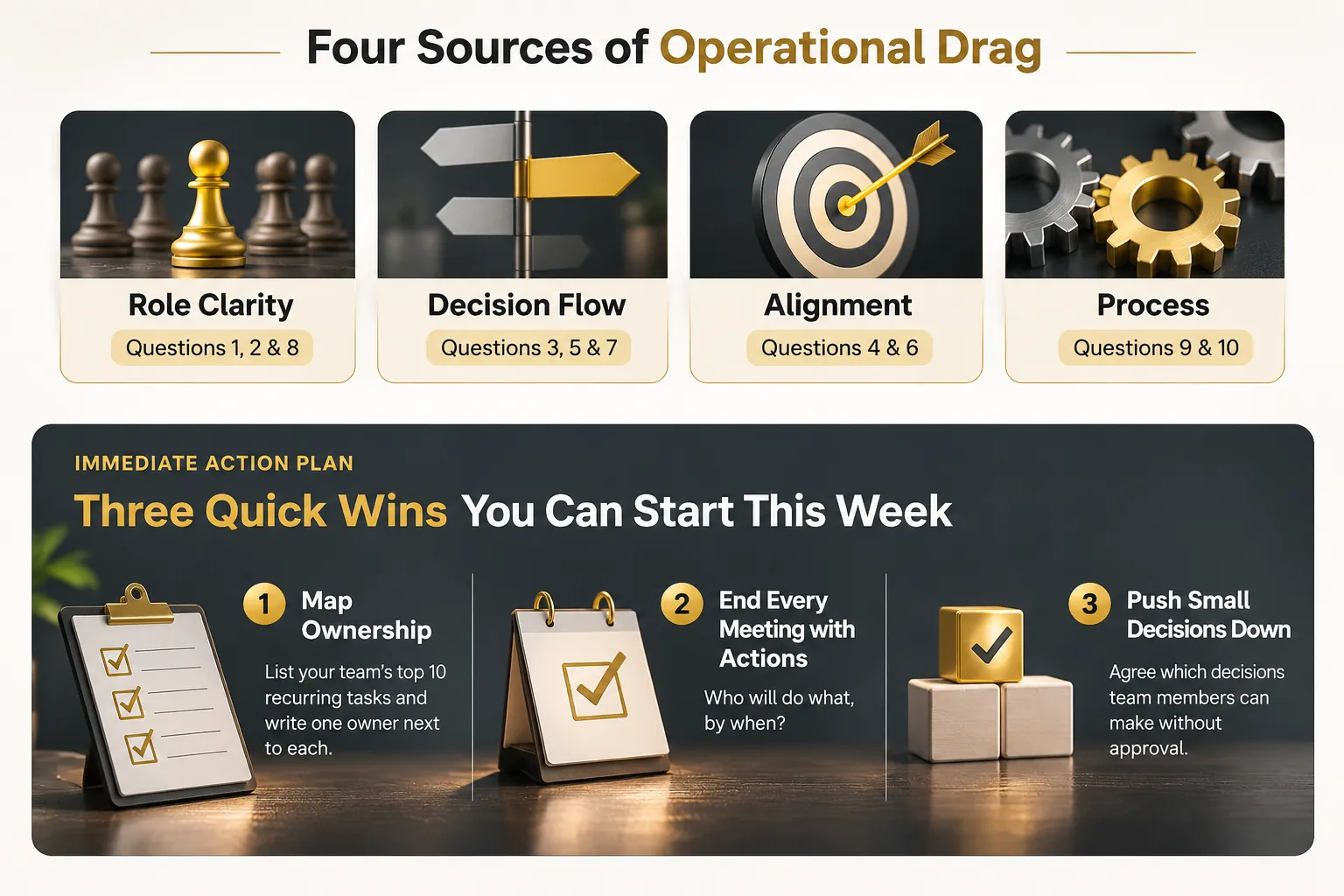
QUESTIONS 1, 2 & 8
Role clarity
Questions 1, 2 and 8: role clarity. People do not know who owns what.
QUESTIONS 3, 5 & 7
Decision flow
Questions 3, 5 and 7: decision flow. Decisions are too centralised or poorly communicated.
QUESTIONS 4 & 6
Alignment
Questions 4 and 6: alignment. Teams work in silos instead of toward shared goals.
QUESTIONS 9 & 10
Process
Questions 9 and 10: process. Ways of working are undocumented or broken.
IMMEDIATE ACTION PLAN
Three quick wins you can start this week
1. Map ownership. List your team's top 10 recurring tasks and write one owner next to each.
2. End every meeting with actions. Who will do what, by when?
3. Push small decisions down. Agree which decisions team members can make without approval.
These steps will not fix everything, but they often release time within weeks.
✓ Key takeaways
Busy does not mean productive.
Operational drag comes from unclear roles, slow decisions, silos and broken processes.
A simple self-check shows where friction lives.
Small structural fixes can free up significant capacity.
Want to know exactly what drag is costing you?
Minji Asia's Operational Drag Audit identifies where time and money are being lost, and gives you a clear plan to recover it.